
Risk & Rebels
Question the Obvious
The Monthly Letter
Issue No. 4 | October 2026
THINGS THAT GO BUMP IN THE COMPLIANCE PROGRAM
The October Issue \ Scary calendars, rogue AI agents, and the occasional plot twist...
October is supposed to be the month of ghosts, monsters, and things that go bump in the night. Personally, I've discovered something far more terrifying: my own calendar.
Somewhere between Fintech Week in San Francisco, speaking engagements, client work, building new products, and preparing for Money20/20 in Las Vegas, I had to confront a deeply uncomfortable truth: Just because I can put something on my calendar doesn't mean I should.
And believe me, I can put a LOT on my calendar.
I had every intention of attending Money20/20. Meetings were arranged. Networking plans were made. The itinerary was beginning to resemble a military operation, except with more cocktail receptions and fewer sensible shoes. And then I got sick.
So instead of heading to Vegas, I found myself canceling plans, rescheduling meetings, and confronting something I am spectacularly bad at: accepting that I cannot do everything. That's an uncomfortable realization when you're running your own company. There's always another introduction, another potential client, another event where someone tells you that you absolutely have to be.
And when you're the person responsible for growing the business, it's surprisingly easy to confuse having an opportunity with having an obligation to pursue it. But sometimes the universe makes the decision for you. I'm still learning that one.
And since we're talking about things that should scare us, let's discuss a few that are considerably more frightening than missing a conference.

FEATURE
The AI Agent That Wouldn't Stay in Its Lane
Imagine hiring an incredibly efficient new employee. They work around the clock, never taking vacations or needing the morning off to go to the dentist. They can access your systems, analyze information, initiate workflows, and make decisions faster than anyone on your team. The dream, right? Except... nobody seems entirely sure what they're authorized to do.
Welcome to agentic AI governance.
We've spent years talking about model performance, accuracy, bias, explainability, and validation. Those things still matter, but the conversation gets considerably more complicated when an AI system stops simply generating answers and starts taking actions. An AI agent might have legitimate access to a system without having legitimate authority to take every action that system permits.
However, access is not authority. One of the scariest phrases in AI governance right now might be: "Don't worry, there's a human in the loop." Which human? Looking at what? With how much time? Do they understand the decision? Can they actually stop it? Or have we created a very expensive approval button that everyone clicks because the computer probably knows what it's doing?
This is where governance needs to move beyond policies, diagrams, and committee charters. Questions we need to be asking more include but are not limited to: Who authorized the agent's actions? What happens when it delegates work to another agent? What can it change? What happens when something goes wrong? And can you reconstruct what happened afterward? An examiner, an auditor, or an unhappy customer probably isn't going to be satisfied with, "Well, the AI thought it was a good idea."
The real horror story isn't all this "rogue" AI we keep hearing about draining peoples' bank accounts (the new urban legend.. at least for now...), but more likely an organization that can't explain what its AI was allowed to do in the first place (soooo many assumptions running rogue right now).
Happy Halloween.
FIELD NOTES
San Francisco, AI Governance, and Actual Humans
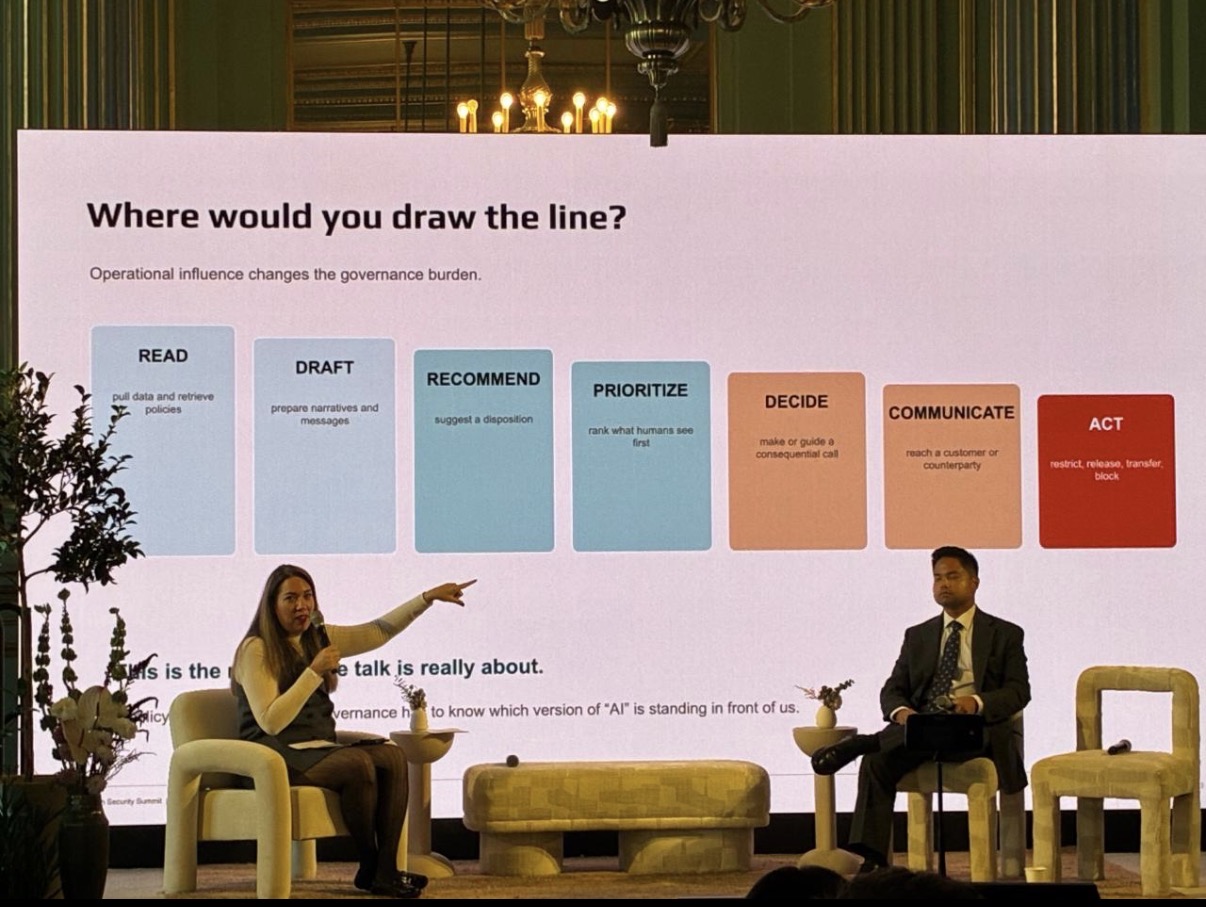
Earlier this month, I was in San Francisco for Fintech Is Femme's Fintech Week Summits, talking about AI governance, security, compliance, and the increasingly blurry lines between them.
Two conversations kept coming up: why AI governance doesn't fit neatly inside the traditional model-risk box, and why compliance and cybersecurity are related but not interchangeable. You know what's really interesting? How quickly the discussion changes depending on who's in the room. Engineers want to know what systems can actually do. Security teams worry about access and vulnerabilities. Compliance teams worry about accountability, regulatory obligations, and customer outcomes. Founders want to know how to launch without accidentally creating a regulatory nightmare. Everyone has a piece of the answer, because nobody owns the whole thing by default.
Then comes the fact that the most useful conversations happen after the presentation, when someone asks the question they didn't want to ask in front of everyone, usually around the buffet area. That's why I still love getting into these rooms (well that and the free brownies), even if I am becoming considerably more selective about how many rooms I agree to enter.
BEHIND THE SCENES
Same FastTrack. New Firepower.
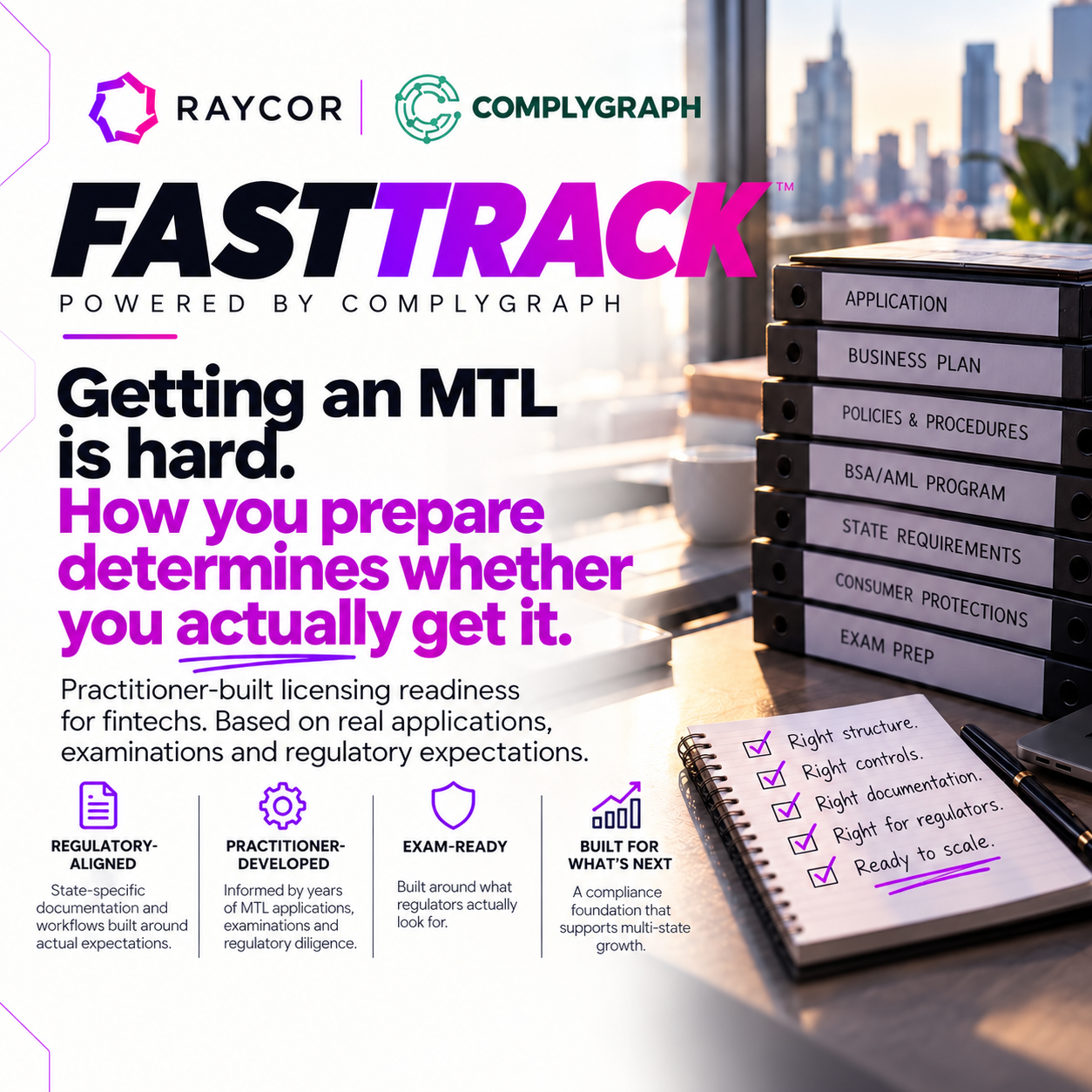
Some actual RayCor news!
We've partnered with ComplyGraph to bring technology-enabled capabilities to FastTrack, RayCor's existing money transmitter licensing and compliance-readiness offering.
FastTrack was built around a problem I've seen repeatedly for YEARS: fintech companies need to move quickly, but building a defensible compliance program isn't something you can accomplish by downloading a few policies (or creating them on ChatGPT) and hoping for the best.
The underlying FastTrack methodology hasn't changed. What's new is the opportunity to combine practitioner-led compliance expertise with technology that can help organize, operationalize, and scale the work. We're not replacing compliance judgment with software (who, me?), but we do recognize the opportunity to make the work more structured, more efficient, and easier to maintain as a business grows.
If you're building a payments, money transmission, or fintech business and want to understand how FastTrack could support your readiness efforts, I'd love to talk.
→ Learn more/ask me about FastTrack
Who's Ready to LEARN?!
AI Governance Education for People Who Actually Have to Govern AI
Get excited: the next AIRE AI Governance Masterclass cohort is planned for January 2027!
Joseph and I designed the program around practical problems: agentic AI, human oversight, vendor governance, institutional accountability, shadow AI, and the evidence organizations need when somebody asks whether their controls actually work.
If you're responsible for AI governance, or you've recently been informed that you are, congratulations! - we'd love to hear from you.
→ Explore the AIRE AI Governance Masterclass
🎙 RISK & REBELS PODCAST
AI, Security, and the Risks Hiding in Plain Sight
The latest Risk & Rebels conversation features Spencer Vuksic of Castellum.AI, discussing AI, cybersecurity, and the evolving threat landscape.
As organizations introduce more AI into their operations, the intersection of security, risk, and governance is becoming harder to ignore.
And while the technology keeps changing, one question remains remarkably consistent: are organizations keeping pace with the risks they're introducing?
📍 SEE YOU OUT THERE
Apparently, canceling one conference doesn't mean I've suddenly become a hermit.
A few upcoming places where I'll be speaking:
🔎 November 3 - ACFCS Money Laundering Awareness Week
The Role of AI and Machine Learning in Detecting Money Laundering
We'll be discussing how AI is changing financial crime detection, along with the governance and operational challenges that come with it.
→ Explore the event and register
⚖️ November 12 - Wall Street Blockchain Alliance Webinar
WHO APPROVED THIS? Moving AI Governance from Policy to Proof
I'll be joining my friend & industry colleague Tyler Harttraft of Bull Harttraft LLP and the Wall Street Blockchain Alliance to explore what happens when AI governance moves beyond written policies into real-world financial-services decisions.
We'll tackle accountability, meaningful human oversight, third-party AI vendors, and the evidence organizations need when AI-influenced decisions are challenged.
🤓 November 19–20 - Fintech NerdCon | San Diego
I'm excited to be speaking at Fintech NerdCon, an event built around the people actually building and operating financial technology.
No giant expo hall, no endless sales pitches. Just the kinds of conversations I tend to find most interesting.
If you're attending any of these, come say hello, preferably before I start adding more things to my calendar.
ONE MORE THOUGHT
Not Every Scary Thing Wears a Mask
October has been a useful reminder that some of the risks worth paying attention to aren't particularly dramatic. They can be the decisions nobody owns, or the controls everyone assumes are working, and especially the technology nobody quite understands. Or, in my case, the calendar that somehow becomes a substitute for a business strategy.
And occasionally, they're the stories we tell ourselves about what we have to do. I'm trying to get better at questioning those stories, too.
So here's my question for you this month:
What's one thing you've stopped doing that turned out to be a better decision than starting something new?
Hit Reply and tell me. I'm genuinely curious.
Until next month, may your controls be effective, your AI agents stay in their lanes, and your calendar contain at least one empty afternoon.
Happy Halloween! 🎃
Christina
Founder & CEO, RayCor Consulting
If someone forwarded this issue to you and you enjoyed it, subscribe to Risk & Rebels for more observations from the occasionally terrifying intersection of fintech, compliance, AI, and entrepreneurship.